
Looking for something?
Emergency Service
24 Hours
Find Your Local Branch...


Open 6 days Littlehampton Clinic
Monday to Friday 8.30am - 6.30pm
Saturday 8.30am - 6.00pm
Sunday Closed
Ask the Vet
How to control fleas ... safely!
Question: I have a new kitten. Should I treat for fleas all year round and what product should I choose? I read recently that many cats die each year from inappropriate product choice.
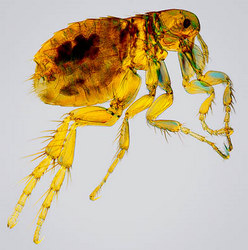 Answer: Many people think that fleas are just a summer problem but you would be wrong to relax! Now is the time of year when it’s particularly important to guard against the re-emergence of fleas – especially with the central heating on. It might be cold outside but your warm home makes an ideal breeding ground for fleas – the risk to your pet never goes away. Wild rabbits, foxes and hedgehogs are just a few examples of permanent reservoirs of infection the whole year round.
Flea fossils date back to the Lower Cretaceous period, meaning fleas have been around for 100 million years. They have had plenty of time to evolve into one of the most difficult parasites to control. Undisturbed and without a blood meal, a flea can live more than 100 days and once active can lay up to 50 eggs and consume 15 times its own body weight in blood in just one day.
Adult fleas are permanent ectoparasites, which means once they have landed on a pet they'll stay there until they're removed by grooming or die. Traditionally, many people have tried to tackle them with products that purely deal with the fleas they see on their pet. This approach is flawed by the fact that so few fleas actually live on the pet at any one time. Only adult fleas live on the animal. But they lay huge numbers of eggs, which promptly fall off the pet. You'd think the answer would be to treat the house with a spray. But even these methods aren't reliable, largely because fleas spend much of their lives protected from insecticides within a cocoon.
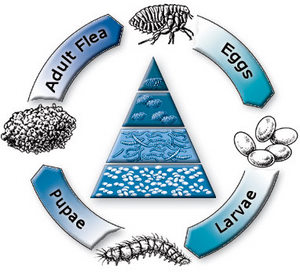 So what is the solution? Actually, it's quite simple. But first, it is essential that you have a basic understanding of the flea life cycle.
A female lays about 2,000 eggs in her lifetime. The eggs are not sticky and they usually fall off of the animal into the carpet, bedding, floorboards, and soil. In two to five days, the eggs hatch. Seen with the naked eye, flea eggs look like large grains of salt.
The eggs hatch into larvae which head toward dark places around your home and feed on "flea dirt" – excrement of the partially digested blood of your pet – and other organic debris. The larvae grow, moult twice, then spin cocoons, where they grow to pupae.
Pupae are usually found at the base of carpet fibres, making them difficult to dislodge with vacuuming. However, vacuuming is recommended because the vibration may stimulate the hatching process after which flea control measures can take effect. Inside the cocoon, fleas are almost impervious to insecticides. The adult flea can emerge from the cocoon after as few as 3 to 5 days, or it can stay in the cocoon for a year or more, waiting for the right time to emerge. Stimuli such as warm ambient temperatures, high humidity, even the vibrations and carbon dioxide emitted from a passing animal will cause the flea to emerge from the cocoon faster.
The adults leave their cocoons, hop onto a host, find a mate and begin the life cycle all over again. Flea saliva contains an ingredient that softens, or "digests" the host's skin for easier penetration and feeding, and is irritating and allergenic -- the cause of all the itching and scratching. Fleas primarily live on mammals and the total flea life cycle can be as short as two weeks or as long as two years, depending on environmental conditions.
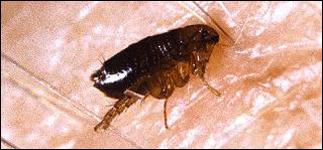 Too often in the zeal to kill fleas people will use many products at once -- a shampoo, then a flea collar and a spot-on treatment after that! Shampoos work well to kill the fleas on the animal, but do not provide any lasting protection. Conventional pet-shop insecticides are designed to last longer but are rarely powerful enough to kill every flea, or kill them before they lay eggs. If just one survives, you could have several hundred more eggs around the house in days! Hundreds of cats die each year because their owners treat them with a dog flea medication containing the insecticide permethrin either accidentally or to save money. Even sharing a bed with a recently treated dog can make a cat fall sick. Permethrin can cause twitching, convulsions and death. It is only found in certain over-the-counter products that pet shops sell. Technology moves apace and I would advise one of the latest prescription-only products available from your vet – these are the most powerful and yet safest agents to use.
